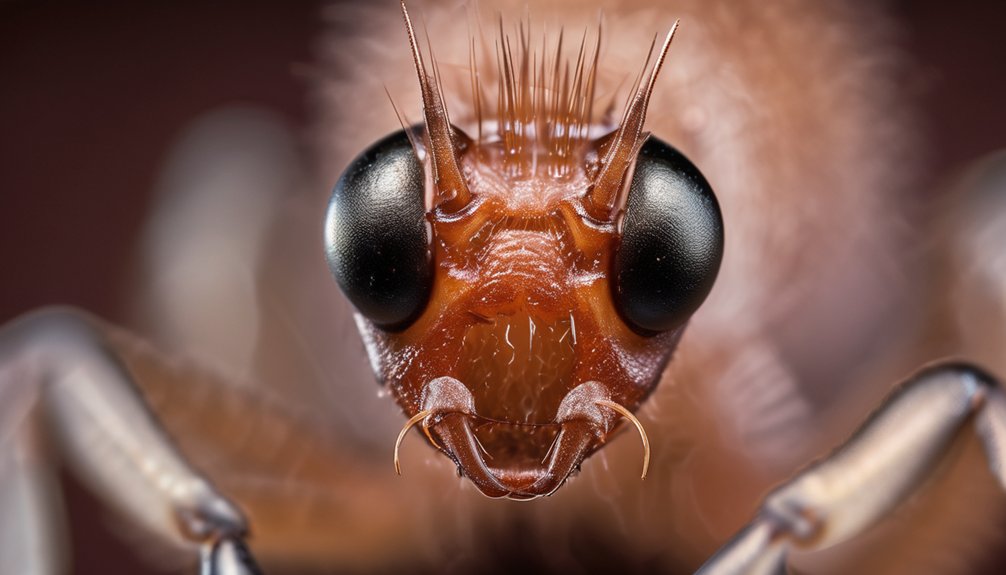
When you look closely at an ant’s face, you’ll see compound eyes made of many lenses that detect movement and light changes, helping the ant navigate. Its antennae constantly move to sense chemical signals and vibrations, guiding it to food and shelter. The mandibles serve as strong tools for cutting and carrying, as well as communication and defense. These features work together to support the ant’s survival in its environment, and exploring further reveals even more about their complex functions.
Structure and Function of Ant Eyes
Although ant eyes may appear simple at first glance, their structure is quite specialized to support their survival and daily activities.
You’ll notice that ants possess compound eyes, which consist of numerous small lenses called ommatidia. These lenses work together to create a mosaic image, allowing you to understand how ants achieve broad visual perception.
While their vision isn’t sharp like yours, it excels at detecting movement and changes in light intensity. This capability helps ants navigate, find food, and avoid predators.
Understanding this structure reveals how ants efficiently interact with their environment despite limited visual detail.
The Role of Antennae in Sensory Perception
Anyone studying ants quickly realizes that their antennae play an essential role in how they perceive the world around them.
These appendages serve as the primary organs for detecting sensory signals, allowing ants to navigate, find food, and communicate. Antennae functions include sensing chemical cues, vibrations, and air currents, which help ants interpret their environment accurately.
When you observe an ant, its antennae constantly move, gathering vital information that guides its behavior.
Understanding these sensory mechanisms reveals how ants interact with their surroundings, emphasizing the importance of antennae in their survival and daily activities.
Mandibles: Tools for Survival and Communication
Mandibles serve as essential tools for ants, enabling them to perform a range of important tasks. Their mandible morphology varies widely among species, adapting to different feeding strategies and environmental demands.
You’ll notice these powerful jaws help ants cut, carry, and manipulate objects, critical for survival. Beyond feeding, mandibles also facilitate communication through gestures and defense mechanisms.
Understanding mandible morphology reveals how ants exploit resources efficiently and protect their colonies. By studying these structures, you gain insight into their complex behaviors and ecological roles, highlighting how such small adaptations support their freedom to thrive in diverse habitats.
Frequently Asked Questions
How Do Ants Clean Their Faces and Sensory Organs?
You’ll see ants using their mandible functions to carefully clean their faces, especially their antennae. They groom their antennae by rubbing them with their legs, keeping sensory organs free and ready for exploration.
What Colors Can Ants Perceive Through Their Eyes?
You can’t expect ants to see the full visual spectrum like humans do; their color perception is limited, mostly detecting ultraviolet and some blue-green hues. This unique view lets them navigate freedom in their world differently than you.
How Does an Ant’s Face Vary Between Species?
You’ll notice ant species diversity shows in facial morphology variations—some have bigger mandibles, others sport unique antenna shapes or eye sizes. These differences help ants adapt, giving each species its own distinct freedom to thrive.
Do Ant Faces Change as They Mature or Age?
You won’t see significant facial changes in ants as they mature; their exoskeleton locks their appearance. Age factors mainly affect wear or damage, not structural changes, so their faces stay pretty consistent throughout their lives.
Can Ants Recognize Each Other by Facial Features?
You can’t rely on ants for facial recognition like humans do, but they use ant identification through chemical cues more than visual traits. So, their freedom to distinguish each other isn’t based on facial features at all.

Christina Pulluck helped bring Nebula Electronics from a a science and tech decision forum to a full-fledged news site by creating a new design and branding. She continues to assist in keeping the site responsive and well organized for the readers. As a contributor to Nebula Electronics, Christina mainly covers mobile news and gadgets.