
What Is an AGM Battery and Why It Outlasts the Rest
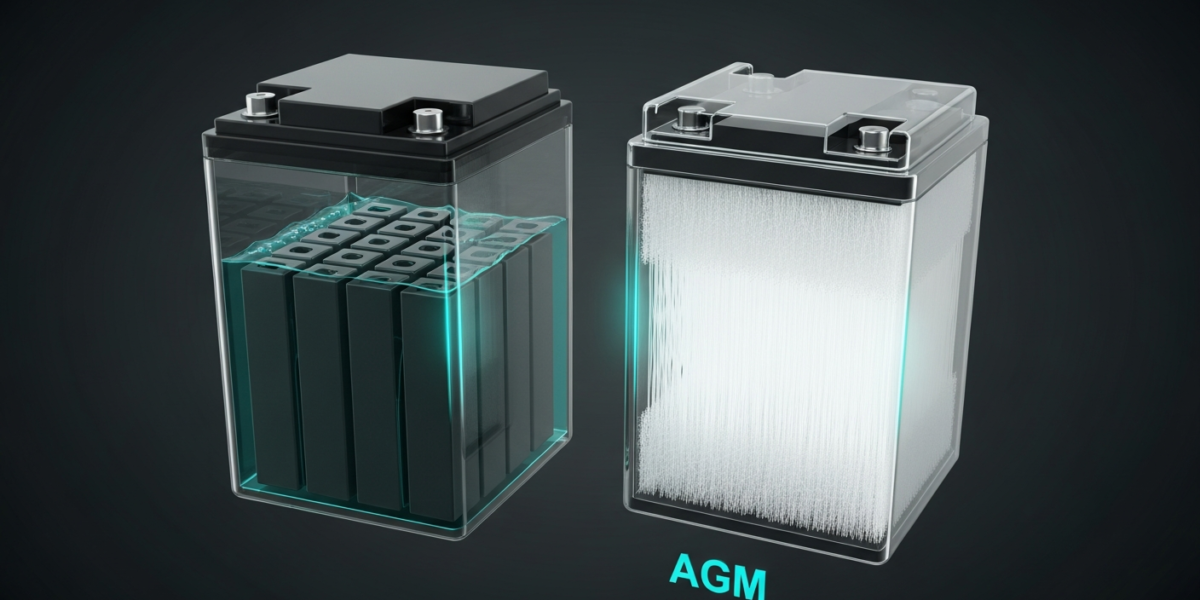
An AGM battery (Absorbent Glass Mat) is a sealed lead-acid battery where electrolyte is held inside fiberglass matting between the plates rather than sloshing as free liquid. That design makes it spill-proof, vibration-resistant, and capable of 300 to 500 cycles at 50% depth of discharge, roughly double the 150 to 250 cycles of a standard flooded battery.
How an AGM Battery Works
In a traditional flooded lead-acid battery, liquid sulfuric acid electrolyte sits between lead plates. The AGM design replaces that liquid with a tightly compressed fiberglass mat saturated with electrolyte. The compression keeps the electrolyte in contact with the plates at all times and holds any gas generated during charging inside the mat so it recombines into water rather than venting out.
The practical results of this construction:
- The battery is fully sealed. There is nothing to spill, no need to check water levels.
- Internal resistance is lower than a flooded battery, which means it can deliver high bursts of current faster. This matters for engine cranking and power tools.
- It handles partial-state-of-charge operation better. Flooded batteries sulfate quickly if left partially discharged; AGM chemistry is more tolerant.
- The sealed design allows installation in almost any orientation except completely inverted.
AGM vs Standard Lead-Acid Battery: Key Differences
| Specification | AGM Battery | Standard Flooded Lead-Acid |
|---|---|---|
| Electrolyte state | Absorbed in fiberglass mat | Free liquid |
| Maintenance | None (sealed) | Periodic water top-up |
| Spill risk | None | Yes if tipped or cracked |
| Vibration tolerance | High | Moderate |
| Typical cycle life | 300 to 500 cycles at 50% DoD | 150 to 250 cycles at 50% DoD |
| Charge acceptance rate | Fast (up to 5x rate) | Slow (standard rate) |
| Self-discharge rate | 1 to 3% per month | 5 to 15% per month |
| Cost premium | 40 to 60% more | Baseline |
| Cold cranking performance | Excellent | Good |
AGM vs Gel Battery: What Is the Difference?
Both AGM and gel batteries are valve-regulated lead-acid (VRLA) batteries, meaning they are sealed and recombine gas internally. The difference is in how the electrolyte is immobilized:
- AGM uses fiberglass matting. The electrolyte is liquid but held in place by the mat’s capillary action. This gives AGM a faster charge acceptance and better cold-temperature performance.
- Gel uses a silica additive that turns the electrolyte into a gel. Gel batteries handle deep discharge better and tolerate heat slightly better, but they charge more slowly and are more sensitive to high-voltage charging. Charging a gel battery with an AGM charger profile will damage it.
For most automotive, marine, and UPS (uninterruptible power supply) applications, AGM is the better fit. Gel batteries are preferred for renewable energy storage where the charge rate is slow and discharge is consistent.
Where AGM Batteries Are Used
Start-Stop Vehicle Systems
Modern cars with automatic start-stop technology (where the engine cuts off at red lights to save fuel) put extreme stress on a battery. The engine restarts dozens of times per trip. Standard flooded batteries wear out within a year or two under this cycle frequency. AGM batteries are standard equipment in start-stop systems from BMW, Mercedes-Benz, Audi, Volkswagen, Ford, and many others because their higher cycle life and faster recharge rate can handle the demand. If your vehicle came with an AGM battery, replacing it with a standard flooded battery will typically cause problems with the start-stop controller and may trigger battery management system warnings.
Solar and Off-Grid Power Storage
Solar panels charge unevenly depending on sunlight, so the battery spends much of its life in a partial-state-of-charge. AGM handles this better than flooded lead-acid. It is a common choice for small to medium solar setups (under 10 kWh) where LiFePO4 lithium batteries are too expensive or the installation temperature range is extreme.
Marine and RV Applications
Boats and recreational vehicles vibrate constantly and change orientation. A spilling flooded battery is a safety hazard in these environments. AGM’s sealed construction and vibration tolerance make it the standard choice for house banks (the batteries that power onboard electronics, not the engine starter).
Uninterruptible Power Supplies (UPS)
The AGM batteries inside desktop UPS units sit on a shelf for months or years before they are needed during a power outage. AGM’s low self-discharge rate of 1 to 3 percent per month means the battery retains most of its charge during long standby periods. A flooded battery in the same role would lose 5 to 15 percent per month and might be flat when you actually need it.
How to Charge an AGM Battery Correctly
AGM batteries require a charger that can deliver a proper multi-stage charge profile. Using a simple single-voltage trickle charger will undercharge an AGM and shorten its life significantly.
A proper AGM charge sequence includes three stages:
- Bulk stage: The charger delivers maximum current until the battery reaches approximately 14.4 to 14.8 V (for a 12V battery).
- Absorption stage: Voltage is held constant while current tapers down until the battery is about 98 percent charged.
- Float stage: Voltage drops to approximately 13.2 to 13.8 V to maintain full charge without overcharging.
Many modern smart battery chargers (CTEK MXS 5.0, Noco Genius G3500, Battery Tender Plus) automatically detect battery type or include a specific AGM mode. Always select the AGM setting if available. Overcharging an AGM battery above 14.8 V causes water loss from the mat, which is irreversible in a sealed battery.
How Long Does an AGM Battery Last?
Service life depends heavily on depth of discharge and charge quality. At 30 percent depth of discharge (meaning you only use 30 percent of capacity before recharging), a quality AGM battery can deliver 600 to 1,200 cycles. At 80 percent depth of discharge, that drops to 150 to 300 cycles. Temperature also matters: AGM batteries age faster at high temperatures. Operating consistently above 40°C (104°F) can cut calendar life nearly in half.
For a car battery with a typical 20 to 30 percent discharge per start cycle, an AGM battery lasts 4 to 6 years under normal conditions. For deep-cycle solar storage with frequent 50 to 80 percent discharges, expect 3 to 5 years depending on charge management.
If you are also replacing small coin cell batteries, the process is very different. See the guide on how to replace an AirTag battery for a step-by-step on CR2032 coin cells. For readers building out a home electronics setup alongside their battery bank, the modem vs router explainer covers the networking side of a self-sufficient home setup.
Frequently Asked Questions
Can I replace a standard car battery with an AGM battery?
Yes, in most vehicles. AGM is a direct drop-in replacement for flooded lead-acid if the physical dimensions and terminal configuration match. Vehicles with a battery management system (BMS), common on European cars from 2010 onward, may require the BMS to be recoded to recognize AGM chemistry. Without recoding, the alternator may overcharge or undercharge the new battery. Check your vehicle’s service manual or consult a dealer before switching battery types.
Do AGM batteries require special chargers?
Yes. A smart multi-stage charger with an AGM mode is strongly recommended. Single-stage trickle chargers do not bring AGM batteries to full charge and cause sulfation over time. Never use a gel battery charge profile on an AGM battery, as the lower voltage ceiling used for gel will chronically undercharge an AGM.
What happens if an AGM battery is fully discharged?
Deep discharge below 10.5 V (for a 12V AGM) causes irreversible sulfation on the plates. The battery loses capacity permanently and may not accept a charge at all after severe discharge. If you accidentally discharge an AGM fully, use a charger with a recovery or desulfation mode immediately rather than a standard charge cycle. Some capacity loss is likely, but recovery is sometimes possible if you act quickly.
Are AGM batteries safe to use indoors?
Yes. Unlike flooded batteries, AGM batteries do not vent hydrogen gas under normal operating conditions. The sealed recombination design keeps gas internal. They can be used in enclosed spaces, inside vehicles, and in confined battery compartments. The only exception is a severely overcharged or damaged AGM, which can vent through the pressure relief valve. Proper charging prevents this entirely.

Dean Prust was a reporter for Nebula Electronics, before becoming the lead editor. Dean has over fifty bylines and has reported on countless stories concerning all things related to technology. Dean studied at Caltech.