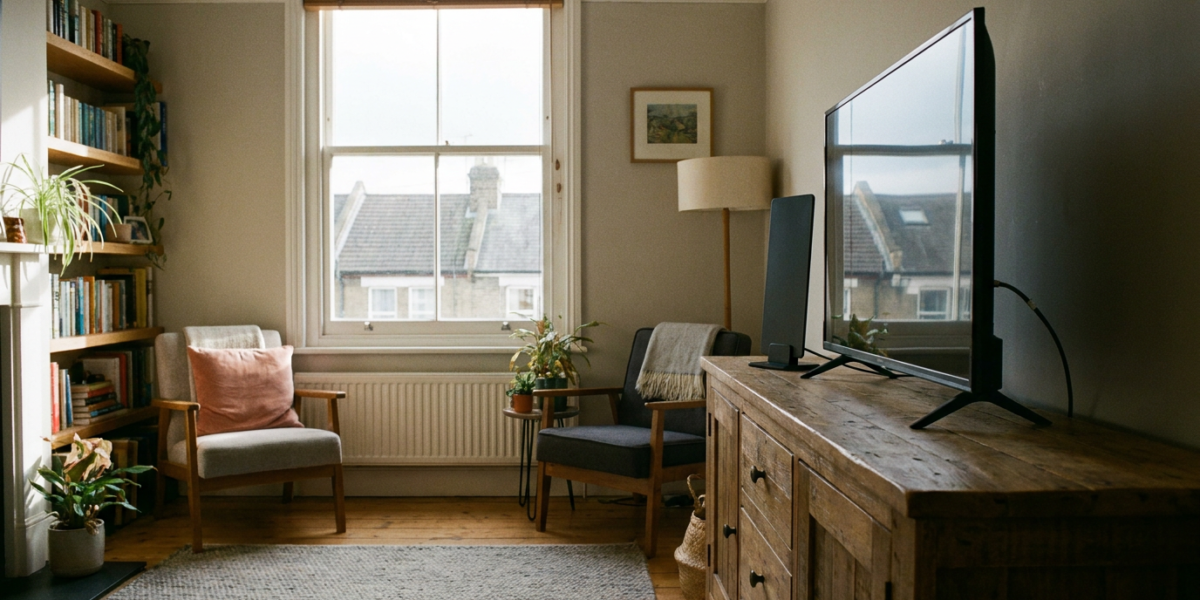
The best indoor TV aerial is one matched to your distance from the transmitter. Close to a strong transmitter, look at a model with a 4G/5G filter, such as the One For All SV 9495.
One For All recommends its indoor aerials for use within 25 km of the nearest transmitter and rates its outdoor models for 0 to 50 km. Beyond that indoor range, One For All’s outdoor models are the ones rated to 50 km.
So check your address before you pick a model. Freeview’s detailed transmitter information page takes your postcode and house number and shows your likely transmitter, the predicted reception and the distance from your home.
Indoor vs loft vs roof aerial: what each position costs you
An aerial works best high up, outside, with nothing in front of it. BBC Reception’s guidance says all TV reception predictions assume an outside aerial 10 metres above the ground. Every step indoors moves you further from that assumption.
| Position | What weakens the signal | When it works | Maker range example |
|---|---|---|---|
| Indoor (set-top or wall) | Walls, plus electrical interference from appliances | Close to a transmitter, strong predicted signal | One For All SV 9495 and SV 9440: 0 to 25 km |
| Loft | Roof tiles and foil-backed insulation | Good reception areas where you want no visible aerial | One For All’s loft category lists the outdoor SV 9453 Yagi and SV 9455: 0 to 50 km |
| Roof | Trees in front of the aerial | Weak predicted signal or a long distance; all predictions assume an outside aerial | SV 9453 Yagi and SV 9455 outdoor: 0 to 50 km |
Source: BBC Reception help guides, Freeview “Do I need an aerial?”, One For All product pages, checked 18 November 2026.
Video: Which?
Amplified or passive: what the booster really does
An amplifier cannot create signal that a wall has already blocked. BBC Reception calls amplifiers a last resort, because even the best one adds some noise, and that noise can break up the picture.
That is why the useful extras on an amplified indoor aerial are the controls around the gain. The One For All SV 9495 has automatic gain control, LED signal level indicators and a 4G/5G block filter. The SV 9440 is an amplified foil design under 1 mm thick, also with a 4G/5G filter.
The common mistake is stacking amplifiers. Freeview’s troubleshooting guide recommends removing unnecessary amplifiers and splitters, because they can overload your equipment or leave it with too little signal.
Loft aerial: hidden, but the roof takes its share
A loft aerial sits higher than a set-top model. The catch is the roof itself. BBC Reception lists roof tiles and foil-backed insulation as obstructions that weaken the signal, and warns you may have problems even where good reception is predicted.
Freeview adds that loft and indoor aerials can pick up electrical interference from household appliances. If your loft has foil-backed insulation, a loft aerial may not work there.
Mount it the right way up, too. BBC Reception notes that, depending on your transmitter, the elements must sit horizontal or vertical, and a qualified installer with local knowledge can tell you which.
When only a roof aerial will do
Go outside when the checker shows weak predicted reception or a long distance to your transmitter. Freeview recommends a wideband aerial, also sold as Type T or Type W, because it covers the full range of digital TV signals.
Freeview puts a typical aerial replacement at £150, based on industry guidance, and suggests getting more than one quote. Use a qualified installer, for example through GetMeViewing, run by the Confederation of Aerial Industries. In a block of flats, ask your landlord about the communal aerial first.
Either way, enter your postcode and house number in Freeview’s transmitter information page before you buy.
The same aerial feeds more than the TV. A USB tuner for watching Freeview on a PC needs exactly the same signal.
Once the picture is stable, you can send the sound to a soundbar over HDMI ARC. And if no aerial position works, connecting your TV to WiFi gets you the broadcasters’ streaming players instead.
Questions about indoor TV aerials
Do indoor aerials work for Freeview HD?
They can, in areas with good reception. One For All lists the SV 9495 for DVB-T and DVB-T2 broadcasts up to 4K, within 25 km of the transmitter. Freeview still warns that indoor aerials can suffer interference from household appliances, so check your channel list after tuning.
Is a signal booster worth adding to an indoor aerial?
Only when the signal is genuinely weak. BBC Reception treats amplifiers as a last resort, because every amplifier adds some noise that can break up the picture. Freeview advises removing any amplifiers you do not need, since they can overload your equipment.
How far from the transmitter can an indoor aerial be?
One For All rates its indoor models for 0 to 25 km and its outdoor models for 0 to 50 km. Walls and roof tiles weaken the signal, and BBC Reception warns of problems indoors even where good reception is predicted, so check your predicted reception first.

Dean Prust was a reporter for Nebula Electronics, before becoming the lead editor. Dean has over fifty bylines and has reported on countless stories concerning all things related to technology. Dean studied at Caltech.