What Does WiFi Actually Stand For? It’s Not What You Think
WiFi does not stand for anything. The Wi-Fi Alliance hired a branding firm called Interbrand in 1999 to create a consumer-friendly name for the IEEE 802.11b wireless standard, and Interbrand invented “Wi-Fi” as a catchy, rhyming play on “Hi-Fi” (high fidelity). The tagline “The Standard for Wireless Fidelity” appeared briefly in early marketing, which started the myth that WiFi is an acronym. It never was. The Wi-Fi Alliance confirmed this publicly, and the phrase “Wireless Fidelity” was dropped from all materials by 2000.
The Real Origin of the Word WiFi
By 1999, the IEEE 802.11b standard existed but nobody outside engineering circles knew what to call it. A consortium of companies including Cisco, Nokia, Aironet, and Intersil formed the Wireless Ethernet Compatibility Alliance (WECA, later renamed the Wi-Fi Alliance) and needed a brand name for certification. The internal working title was “IEEE 802.11b Direct Sequence,” which, as branding goes, was a commercial non-starter.
Interbrand proposed ten names. WECA chose “Wi-Fi” because it was short, memorable, and rhymed with Hi-Fi. The hyphen was stylistic, not structural. There was no expansion of the letters. Wi-Fi was simply a brand name with no literal meaning, the same way Häagen-Dazs means nothing in any language.
Phil Belanger, one of the Wi-Fi Alliance’s founding members, wrote about this explicitly in a post widely cited in technology circles: “Wi-Fi doesn’t stand for anything. It is not an acronym. There is no meaning.”
What IEEE 802.11 Actually Means
The technical standard behind every WiFi network does have a structured name. Here is how it breaks down:
- IEEE = Institute of Electrical and Electronics Engineers, the body that defines the standard
- 802 = the IEEE committee number for networking standards (LAN and MAN protocols)
- 11 = the working group number for wireless local area networks
- Letters like a, b, g, n, ac, ax = amendments to the base standard, each adding new capabilities
So 802.11ax, the current mainstream standard, translates roughly to “the ax amendment to wireless LAN standard 11 from IEEE committee 802.” Not a brand anyone would buy a router for.
Every WiFi Generation, Named and Explained
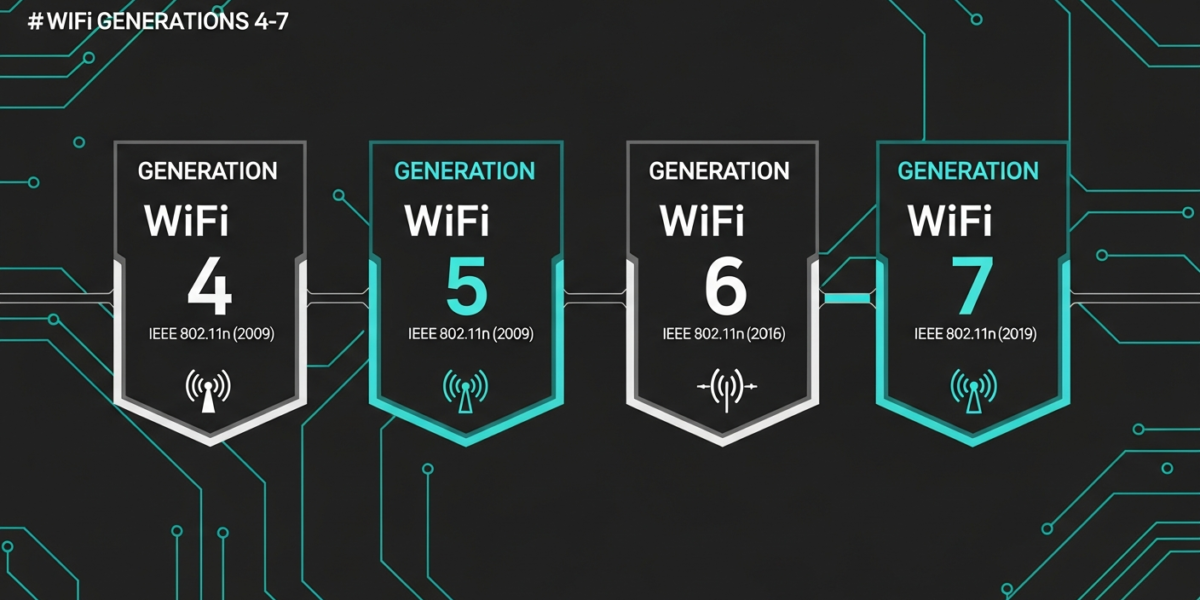
The Wi-Fi Alliance introduced consumer-friendly generation numbers in 2018 to replace the confusing letter suffixes. Here is the complete lineage:
| Generation name | IEEE standard | Year | Max speed (theoretical) | Frequency |
|---|---|---|---|---|
| WiFi 1 | 802.11b | 1999 | 11 Mbps | 2.4 GHz |
| WiFi 2 | 802.11a | 1999 | 54 Mbps | 5 GHz |
| WiFi 3 | 802.11g | 2003 | 54 Mbps | 2.4 GHz |
| WiFi 4 | 802.11n | 2009 | 600 Mbps | 2.4 GHz + 5 GHz |
| WiFi 5 | 802.11ac | 2013 | 3.5 Gbps | 5 GHz |
| WiFi 6 | 802.11ax | 2019 | 9.6 Gbps | 2.4 GHz + 5 GHz |
| WiFi 6E | 802.11ax (6 GHz) | 2021 | 9.6 Gbps | 2.4 GHz + 5 GHz + 6 GHz |
| WiFi 7 | 802.11be | 2024 | 46 Gbps | 2.4 GHz + 5 GHz + 6 GHz |
WiFi 1 through 3 are effectively extinct in new hardware. If your router or device mentions 802.11n, it is WiFi 4 and still functional but aging. Most homes today run WiFi 5 or WiFi 6 hardware. A dual-band router broadcasting on both 2.4 GHz and 5 GHz is a WiFi 5 or WiFi 6 device in the vast majority of households.
How WiFi Actually Works
WiFi transmits data using radio waves in the 2.4 GHz, 5 GHz, and (with WiFi 6E and 7) 6 GHz frequency ranges. Your router broadcasts a radio signal. Your device’s wireless adapter receives it and sends its own signal back. This two-way radio conversation is coordinated using OFDM (Orthogonal Frequency Division Multiplexing), which splits one radio channel into dozens of smaller sub-channels to carry data simultaneously.
The practical implication: the 2.4 GHz band travels farther and passes through walls more easily because lower-frequency radio waves lose less energy to physical materials. The 5 GHz band carries more data faster but over shorter distances, because higher-frequency signals attenuate more quickly in air and through solid objects. This tradeoff is why choosing the right WiFi channel matters so much in apartments, where 20 to 50 networks compete for the same radio space.
WiFi vs Ethernet: What the Name Does Not Tell You
WiFi and ethernet both connect you to your local network and from there to the internet. The critical difference is the medium: radio waves vs a physical copper cable. Ethernet eliminates all radio interference, multipath fading, and congestion from neighboring networks. A gigabit ethernet connection delivers a consistent, predictable 940 to 980 Mbps with latency under 1 ms. WiFi delivers variable speeds depending on environment, with latency typically 2 to 20 ms.
For activities where consistency matters more than speed (video calls, gaming, financial transactions), ethernet wins regardless of how fast your WiFi is. For everything else, modern WiFi 5 and WiFi 6 are fast enough that the difference is invisible in daily use.
The device that bridges your ethernet home network to the internet is your modem. The device that distributes WiFi inside your home is your router. Many homes combine both in a single box, but they remain two distinct functions. If you have ever wondered which one actually connects to the internet, the modem vs router explainer breaks down exactly where each device sits in the chain.
Why “Wireless Fidelity” Stuck Around as a Myth
The confusion persists because the Wi-Fi Alliance used the phrase “The Standard for Wireless Fidelity” in some early 1999 and 2000 marketing materials as a descriptor, not as an expansion of the acronym. It appeared on a few press releases and was quickly dropped, but the internet preserved it. By 2003, Wikipedia had it listed as the full name. Corrections followed, but myths move faster than corrections.
Today the Wi-Fi Alliance’s official position is unambiguous: Wi-Fi is a brand name. It stands for nothing. The same applies to related terms: WPA (Wi-Fi Protected Access) and WPS (Wi-Fi Protected Setup) are actual acronyms, but “Wi-Fi” itself is not.
Frequently Asked Questions
Does WiFi stand for Wireless Fidelity?
No. WiFi is a brand name coined by the branding firm Interbrand in 1999. It does not stand for Wireless Fidelity or any other phrase. The Wi-Fi Alliance confirmed this. The “Wireless Fidelity” phrase appeared briefly in early marketing as a tagline and was dropped by 2000.
Who invented WiFi?
The underlying 802.11 radio communication standard was developed by the IEEE, with significant contributions from CSIRO (Australia’s federal science agency), whose researchers including John O’Sullivan developed key techniques for handling multipath signal interference. CSIRO held patents on core WiFi technology and received over $430 million in licensing settlements from companies including Microsoft, Intel, Dell, and AT&T between 2009 and 2012.
What is the difference between WiFi and the internet?
WiFi is your local wireless network inside your home or building. The internet is the global network of networks that your modem connects to. WiFi without an internet connection still works for local file sharing and device communication. Internet without WiFi works fine over ethernet. The two are independent; WiFi is just one way to reach the internet from inside a building.
Is WiFi the same as a hotspot?
A hotspot is a WiFi access point that shares a cellular data connection. Your phone’s personal hotspot creates a small WiFi network using your cellular data as the internet source. The WiFi part is technically identical to your home network; only the internet source differs. Home WiFi uses a fixed broadband connection (cable, fiber, DSL). A hotspot uses 4G or 5G cellular data.

Dean Prust was a reporter for Nebula Electronics, before becoming the lead editor. Dean has over fifty bylines and has reported on countless stories concerning all things related to technology. Dean studied at Caltech.